

PRESIDENTIAL PATRONAGE "SELJUK SOURCES COLLECTION" HISTORICAL STEP:
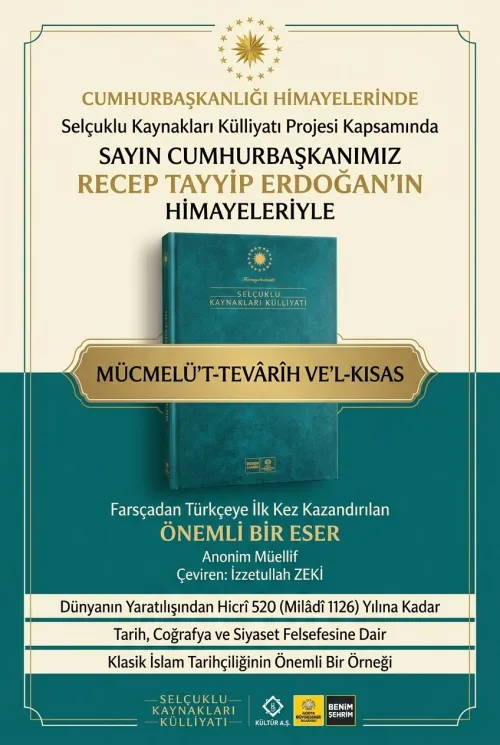
THE MÜCMELÜ’T-TEVÂRÎH AND’L-KISAS FIRST TIME TRANSLATED INTO TURKISH BY ASSOC. PROF. DR. İZZETULLAH ZEKİ
Within the scope of the Seljuk Sources Collection Project conducted under the patronage of the President of the Republic of Turkey, Recep Tayyip Erdoğan, the masterpiece titled Mücmelü’t-Tevârîh and’l-Kısas (Summary of Histories and Tales), which holds great significance in terms of Islamic and Turkish historiography, has been translated into Turkish for the first time from its Persian original by Assoc. Prof. Dr. İzzetullah Zeki and presented to readers. This valuable work, published by Konya Metropolitan Municipality Culture Publications (KÜLTÜR A.Ş.), adds a new dimension to Seljuk period and Turkish history research.
Revival of National Memory and Seljuk Heritage
In the work published with the presentation of the President of the Republic of Turkey, Recep Tayyip Erdoğan, the strategic importance of correctly understanding the Seljuk heritage in terms of national consciousness and historical awareness is emphasized. The "Seljuk Sources Collection" project, which brings together the main sources scattered in different languages and libraries; aims to strengthen our connection with our roots, eliminate historical deficiencies, and pass our thousand-year heritage to future generations with primary sources.
Importance of 'Mücmelü’t-Tevârîh and’l-Kısas' in Terms of Turkish History and Culture
The work, written in the year 520 AH (1126 AD) by an anonymous/unknown author, addresses world history from creation in a chronological and encyclopedic integrity. The main characteristics that highlight the work in terms of Turkish and Islamic history are as follows:
Origins and Clan Structures of the Turks: From the 10th chapter of the work, the origins, clan structures, and areas of dominance of the Turks in the eastern geography are discussed in detail.
Political and Cultural Panorama of the Seljuk Period:
The work written during the era of the Great Seljuk State directly reflects the understanding of the state, social structure, and cultural world of the period.
Illuminating Lost Sources: The author serves as a unique bridge in historical transmission by quoting from many lost works that have not survived to the present day, in addition to sources such as Taberî, Hamza el-İsfahânî, and Şehnâme.
Critical Historical Understanding:
The work is one of the rare examples of early critical historiography that not only conveys events but also compares and evaluates different narratives.